Practical guide
Acupressure Mats vs Manual Pressure: Checking Product Claims
Identify the actual product and claim, then compare it with the intervention, participants, comparator and outcomes in original research. The two reports checked here do not rank mats against manual pressure. Keep product restrictions beside benefit claims and save a narrow conclusion with remaining questions.
Identify the contact before comparing benefits
An acupressure mat and manual acupressure both involve external pressure, but they are not the same intervention. A mat distributes contact across many spikes. Manual pressure targets a selected area with a hand or finger. Needle acupuncture inserts needles into the skin. Evidence about one method cannot be transferred simply because a product page calls all three “acupoint stimulation.”
| Method | Actual contact | What to check |
|---|---|---|
| Spike mat or pad | Many projecting tips contact the body; device designs differ. | Maker, model, size, materials and the device actually studied. |
| Manual acupressure | A hand or finger applies pressure at a selected area. | The actual procedure and study; a mat trial is not a manual-pressure comparison. |
| Needle acupuncture | Fine needles are inserted into the skin. | Needling results and risks remain method-specific. |
Cleveland Clinic describes manual acupressure as pressure with the fingers, commonly the thumbs. NCCIH defines acupuncture by needle insertion. These definitions help identify the method; they do not establish which product will help you or whether external pressure is personally appropriate.
Start a claim record with the exact sentence, the page and the date. “Feels relaxing,” “improves sleep,” “boosts circulation” and “treats chronic pain” are different claims. A comfort preference, a measured sleep score and a disease-treatment result should not share one evidence label.
What two original mat and pad reports actually tested
The two selected original reports below illustrate why the device and comparator matter. This is a focused source check, not an exhaustive systematic review or a ranking of every mat brand. Neither report compares a mat directly with manual finger pressure.
| Original report | Participants and comparison | Result and important limit |
|---|---|---|
| Kisker and Schöne; first published 2023, journal issue 2024 | 62 young students randomized: 32 to an original ShaktiMat with 6,210 tips, 30 to no-tools relaxation; three-week home training. | No significant advantage of the mat condition was found. Some self-rated outcomes changed across groups; this is not a manual-pressure or clinical pain-treatment trial. |
| Hohmann and colleagues, 2012: neck-pain pilot | 40 randomized; 35 complete cases analysed, 17 pad and 18 waiting-list. A 22 × 33 cm Zhencidian pad with 1,140 nonpenetrating plastic spikes; two weeks. | The adjusted between-group pain estimate favored the pad by 1.6 points on the 0–10 scale, with a 95% interval from 0.3 to 2.8 points favoring it. Open pilot, waiting-list comparison and incomplete neck follow-up. |
| Hohmann and colleagues, 2012: lower-back-pain pilot | 42 randomized and analysed, 21 per group; the same pad and two-week comparison. Stable existing medicines and physiotherapy were allowed in both pilots. | The adjusted pain estimate favored the pad by 2.3 points, with a 95% interval from 1.3 to 3.2 points. The disability measure did not show a significant between-group difference. |
In the student study, perceived stress decreased and reported sleep quality improved across groups, while reported overall well-being decreased. The authors discuss limited reliability of the well-being and sleep questionnaires. Concentration-test improvement was also discussed in relation to practice effects. Do not summarize this mixed pattern as “the mat improved every measure.” Blood pressure, heart rate, pain threshold and pain tolerance did not show significant pre-to-post changes.
The study acknowledges that ShaktiMat supplied 60 mats free of charge; the authors declare no conflicts of interest. It explicitly describes its registration as retrospective. Those disclosures belong beside the result. The randomized total is also not automatically the number analysed for every outcome.
The pain pilots reported discomfort or pain, particularly early in use, and no other adverse effects. They excluded people with current anticoagulation, bleeding tendencies and certain skin or other conditions. Their waiting-list comparison, complete-case analysis and short duration limit the conclusions. A favorable pain estimate is not proof of lasting benefit, universal safety, better sleep or superiority to manual pressure.
The study procedures describe what participants did under those research conditions. They are not home-use instructions. A nonsignificant difference also does not prove equivalence: the design and uncertainty must support that separate conclusion.
Match the advertisement to the evidence it would need
On the checked Shakti website, the homepage presents sleep, pain and stress benefits; its how-to page links use to relaxation and circulation. The examples below examine those types of claims without endorsing a product. Preserve the wording on the current page because advertisements and models change.
| Claim or signal | Relevant evidence question | Bounded conclusion from this check |
|---|---|---|
| Stress relief | Was the mat compared with a credible alternative that also allowed rest? | The student study found no significant mat advantage over no-tools relaxation. Do not attribute changes across both groups solely to spikes. |
| Better sleep | Which sleep measure, population, comparator and reliability? | Student self-reports and questionnaire limitations do not establish treatment for insomnia or superiority to manual pressure. |
| Pain relief | Which pain condition, pad and time window? | The small 2012 pain pilots supply a short-term signal for their particular pad and comparison, not every current product or all functional outcomes. |
| Circulation in a fixed number of minutes | Was the claimed circulation endpoint actually measured at that time? | Blood pressure and heart rate are not direct measurements of the advertised circulation benefit. The checked student design does not establish that fixed-time claim. |
| Thousands of tips or sharper spikes | Was one design compared with another for relevant outcomes and harms? | Tip count and sharpness are specifications. These two reports do not establish that more or sharper is better. |
| Verified reviews or ancient tradition | Does the signal supply a controlled comparison of this product? | Customer reviews and historical framing are not clinical trial results or an estimate of your chance of benefit. |
A genuine customer can describe a genuine preference without proving causation. Rest, expectations, other care, selection of reviewers and changes over time can affect an account. A “verified buyer” label concerns a purchase-review process; it does not create a blinded trial or ensure that unwanted experiences were systematically collected.
Ask for the original report when a claim cites “research.” Compare its actual methods with the product label. A review of manual or auricular acupressure may be useful for that separate intervention, but it cannot silently become a product-specific mat review.
Read the manufacturer’s restrictions separately from its benefits
Warnings can be more specific than the reassuring headline. The checked Shakti medical-condition FAQ states not to use its mat or accessories with coagulation issues or anticoagulant medication. It also lists restrictions involving significant skin damage, neuropathy with loss of sensation, cardiovascular conditions and other circumstances. It recommends consulting a physician for other medical conditions or pregnancy questions.
This attributes the manufacturer’s instructions; it does not independently validate the mechanisms offered for each warning. Preserve the actual restriction for the actual product. “Ask a clinician” should not be rewritten as “use anyway,” and an attractive review should not erase a do-not-use statement.
- Find the full product instructions and medical-condition warnings, not only the sales summary.
- Keep the maker and model beside the warning; accessories can have different contact arrangements.
- Record an absent or unclear instruction as unresolved rather than assuming there is no restriction.
- Take personal medicine, skin, sensation or pregnancy questions to qualified care through the usual appropriate channel.
The maker’s duration FAQ also says there is no time limit. That statement does not establish that indefinite exposure or sleeping on a mat is safe for everyone. Do not derive a pressure schedule from a commercial FAQ or from these research summaries. Cleveland Clinic warns against pressure causing discomfort, pain or bruising and advises discussing a worsening response before trying again.
Do not stop or change prescribed medicine to make a product usable. MedlinePlus explains that bleeding is the most common side effect of blood thinners and identifies signs requiring provider contact. If symptoms need prompt assessment, obtain appropriate local care; a shopping comparison or worksheet is not a triage service.
Check materials and model identity before importing a study
The materials FAQ describes different fills: polyurethane foam for the Classic mat and pillow, and Blissfoam for Premium products. A separate latex-allergy FAQ describes washing and cotton layers but says the maker cannot confirm individual circumstances. “Plant-based” should therefore not be converted into “safe for every latex allergy.” Ask about the actual model and materials when an allergy matters.
Likewise, a textile certification claim concerns its stated certification scope; it is not a clinical efficacy certificate. This article has checked what the manufacturer says, not independently audited its materials, certification or manufacturing process.
The smaller pad in the 2012 pain studies and the original 6,210-tip mat in the student study have different designs. New product names, foam, accessories or intensity levels need their own identification. Neither the similar appearance nor a larger contact area establishes the same effect. A product specification is useful precisely because it stops unlike devices from being treated as interchangeable.
Three fictional claim notes you can inspect
These are original reading examples, not customer interviews or tests of products.
1. A buyer interested in winding down
Claim: “This mat guarantees better sleep.” Evidence note: the student study used a mat versus no-tools rest; its sleep questionnaire had reliability limitations and it did not establish a mat advantage. Honest conclusion: a person may have a comfort preference, but this report does not establish the guarantee or treatment for insomnia.
2. A pain claim attached to a newer model
Claim: “This new mat is clinically proven for every back problem.” Evidence note: the 2012 lower-back pilot used a specific small pad, selected participants and a waiting-list comparison over two weeks. Honest conclusion: retain the favorable short-term pain estimate and the absent significant disability advantage, then leave the new model and broader conditions unresolved.
3. A product with a stated medication restriction
Claim: “Non-invasive means suitable with any medicine.” Instruction note: the checked manufacturer says not to use with anticoagulant medication. Honest conclusion: the marketing category does not override that warning. The fictional reader keeps prescribed care unchanged and brings the actual instructions to the professional managing it.
The useful output is a narrow conclusion with a visible unanswered question. You do not need to buy, test stronger contact or recreate discomfort to complete the reading task.
Download the claim and instruction record
Download the editable twelve-field claim record. It keeps the advertised sentence, actual device, matched evidence, restrictions and unresolved questions together. The file also includes these practice checks and separate answer notes.
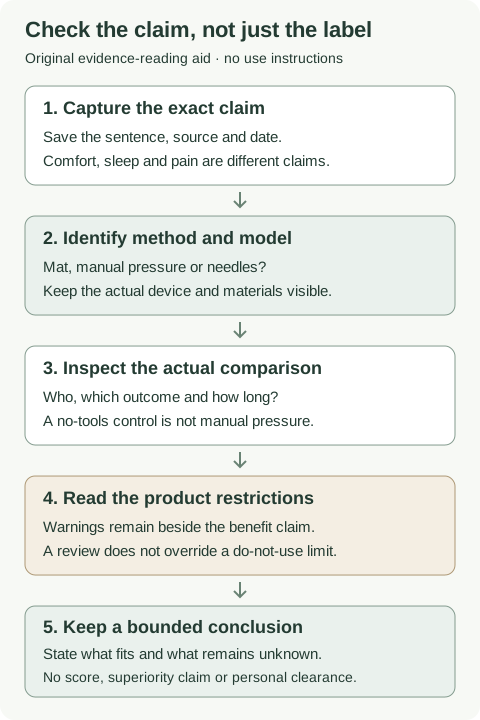
This is an original reading aid without a validated score. It does not submit your notes. You can leave health details out and use your clinician’s usual channel for private information. For the separate task of describing actual use or an unwanted experience, use the clinician-preparation guide.
Six checks before accepting a product claim
Try these original evidence and instruction checks before opening the explanations. They do not assess your symptoms or select a treatment.
Case 1
An advertisement for a spike mat cites a trial of needle acupuncture. Does sharing the term “acupoint” make that trial evidence for the mat?
Show answer and explanation for case 1
No. Identify what actually touched or entered the body. A needle-acupuncture trial does not establish a spike mat’s effect.
Match the intervention, product, participants, comparison and outcome before using a result. A shared traditional point name is insufficient.
Case 2
The 2023 mat study compared a mat with no-tools relaxation. Can its result establish that a mat is better than finger pressure?
Show answer and explanation for case 2
No. Finger pressure was not the comparator in that study.
The checked study did not show a significant mat advantage over its active relaxation control. That does not rank a comparison it never made, or prove that all methods are equivalent.
Case 3
The 2012 pain pilots reported discomfort or pain but no other adverse effects. Is “no unwanted experiences” an accurate summary?
Show answer and explanation for case 3
No. Keep the reported discomfort and pain in the summary.
A limited adverse-effect report is not universal safety evidence. The trials also excluded people with several medical risks and observed a short treatment period.
Case 4
A newer product has a different size and foam from the pad in a pain trial. Does its larger spike count prove a better result?
Show answer and explanation for case 4
No. A design specification is not a measured clinical outcome or a head-to-head comparison.
Record the actual model, materials and contact arrangement. Evidence from a different device needs an applicability assessment; a higher count does not establish greater benefit.
Case 5
A duration FAQ says there is no time limit. Does that establish that sleeping on any mat is safe for anyone?
Show answer and explanation for case 5
No. A manufacturer statement is not a study establishing unlimited safe exposure.
Do not extend a promotional duration statement into advice for every person or model. Preserve the product’s warnings and discuss unresolved personal safety questions with qualified care.
Case 6
A review calls a mat relaxing, while the product warning says not to use it with anticoagulant medication. Should the review erase that warning?
Show answer and explanation for case 6
No. A testimonial does not override the manufacturer’s stated restriction.
Do not stop prescribed medicine or try a different point to work around the restriction. Bring the actual product instructions and medicine context to the professional managing your care.
Sources and further reading
- Kisker and Schöne: Original three-week mat versus relaxation study (2023 / 2024)All visible original sections, complete tables and disclosures read in the normal browser; bibliography accordion not expanded. Active control, mixed self-reports and evidence limits retained.
- Hohmann and colleagues: Two original neck and lower-back pain pad pilots (2012)Complete original PMC article and bibliography read. Device, complete-case populations, Table 2 estimates, waiting-list limits and reported discomfort retained.
- Shakti: Homepage marketing claimsManufacturer marketing examples, not clinical validation, verified review methodology or endorsement.
- Shakti: How to use — manufacturer instructionsManufacturer method and duration statements attributed; no pressure schedule adopted.
- Shakti: Medical-condition restrictionsExact product restrictions remain separate from marketing; the offered mechanisms are not independently validated here.
- Shakti: Duration FAQManufacturer unlimited-time statement is not universal safety evidence or a recommended exposure.
- Shakti: Materials by product familyProduct-family materials are attributed maker statements; certification not independently audited.
- Shakti: Latex-allergy FAQMaker cannot confirm individual allergy circumstances; no allergy clearance given.
- Cleveland Clinic: What Is Acupressure and Does It Work?Complete patient education previously read; exact current plaintext equality checked. Finger-pressure definition and stop-if-worse advice, without treatment recipes.
- NCCIH: Acupuncture—Effectiveness and SafetyComplete fact sheet previously read; exact current plaintext equality checked. Needle insertion distinguishes acupuncture; evidence is not transferred to a mat.
- MedlinePlus: Blood ThinnersComplete current patient education read. Medicine types and bleeding warning context; no medication change or personal risk calculation.