Practical guide
Talking to a Clinician About Acupressure: A Preparation Checklist
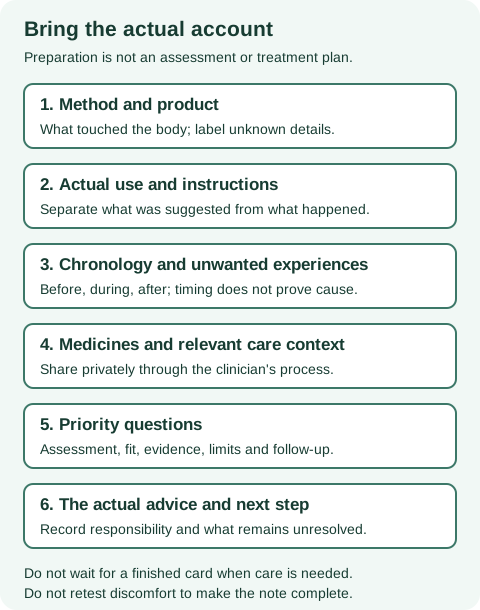
Bring the actual method, product instructions, use and symptom chronology, medicines and your priority questions. Keep unknowns visible, and record the clinician’s actual advice separately from what you hoped to hear.
Start with the actual method and the reason for the visit
Tell your clinician what you are using, what you hoped it would help, how you actually used it and what happened afterward. Bring the product name or instructions if a device is involved. You do not need a confident point name or a theory about the cause of a symptom to start the conversation.
An opening you can adapt is: “I have been using [method or product] for [reason] since [date or approximate period]. I used it on [body area] in this way. I noticed [change or discomfort], and I would like help deciding what that means and what is appropriate next.” Fill only what you know; a plain description is more useful than guessing a technical label.
NCCIH’s four communication tips recommend listing complementary practices, bringing a list of medicines and supplements, asking about safety and effectiveness, and starting the conversation rather than waiting to be asked. Those are general patient communication recommendations, not evidence that this worksheet or an acupressure product improves a measured outcome.
This guide prepares a discussion; it does not select a point, pressure level, schedule or treatment. If a symptom needs prompt attention, do not wait for a routine appointment or a completed record. Use appropriate local medical help or your existing care instructions.
Describe contact, the product and what you actually did
Separate the label from the action. “I used a wristband sold as an acupressure band” identifies how it was advertised. “It had a raised part contacting the inside of my wrist” describes what touched your body. If you used hand pressure instead, say that; if somebody else applied the method, explain that context.
Needles, electrical stimulation, heat, suction and hand pressure should not be merged into one account. NCCIH defines acupuncture as inserting fine needles into the skin, sometimes with manipulation or electrical stimulation. Its acupuncture results and needle-related risks do not establish the effects or safety of your pressure method or a wearable product.
| Detail | Bring or describe | Keep this uncertainty visible |
|---|---|---|
| Method actually used | Fingers, another person’s hands, or the specific product or procedure. | Do not use “acupressure” as a substitute for describing needles or electrical stimulation. |
| Product identification | Name, manufacturer and model as printed; packaging or a readable label photo. | A familiar marketing term does not identify every product with that name. |
| Source of instructions | Product leaflet, video, website or advice you actually received. | A source URL helps the clinician see the claim; it is not proof the claim is correct. |
| Body area and side | Where contact occurred, in your own words; the point label only if known. | A point code is not confirmation that the actual location matched it. |
| Actual use | Start period, approximate duration and frequency, including changes. | Report what happened rather than copying the intended routine as if you completed it. |
| Sensation and skin change | Your words for comfort, pressure, pain, tingling, redness or another change. | Do not use discomfort as proof that you found the right spot. |
| Purpose and other care | What you hoped to address and other care used at the same time. | Improvement afterward does not isolate the method as its cause. |
| Missing information | Unknown model, uncertain time or instructions you no longer have. | Preserve an unknown rather than inventing precision. |
You do not need to repeat a technique during the visit just to demonstrate it. A description, packaging or the instructions may be enough to start. Ask whether a demonstration is needed and appropriate. Do not press an uncomfortable area again to make the symptom visible.
If the instructions differ from what you actually did, keep both facts: “The leaflet said X; I did Y.” If you cannot reconstruct duration or pressure, say “estimated” or “unknown.” There is no conversion from a feeling such as “firm” to a measured pressure in this record.
Write a chronology without diagnosing the cause
“My hand tingled while I was wearing the band” gives a clinician a place and sequence to ask about. “The band damaged a nerve” adds a diagnosis the note cannot establish. Record symptoms in ordinary words, including where they occurred, whether they persisted and what you did next.
| When | Record the observation | Do not silently add |
|---|---|---|
| Before use | What was already present; the reason you tried the method. | Avoid attributing an older symptom to a later exposure. |
| During contact | When a new sensation started and where you felt it. | Timing is an observation, not a diagnosis. |
| After stopping | What changed, persisted or remained uncertain. | Do not retest the method to prove a cause. |
| Other changes | Medicines, another product, an activity or illness that changed around the same time. | Several changing factors prevent a simple cause claim. |
| Later account | What you remember and what was written at the time. | An approximate recollection should remain labeled approximate. |
Include experiences you did not want even if you are unsure they are related: discomfort, a skin change, feeling worse or no improvement. A clinician can assess the significance and possible causes. The purpose of the record is to preserve the observation, not to decide a formal adverse-event category or prove product fault.
Cleveland Clinic’s acupressure introduction advises discontinuing self-acupressure and discussing it with a licensed professional before trying again if it makes you feel worse. It also warns against pressure that causes bruising, discomfort or pain. This is patient education, not individualized assessment of a reader’s new symptoms.
Do not deliberately recreate pain, numbness or another unwanted experience for this worksheet. If symptoms are new, severe, worsening or otherwise concerning, seek appropriate assessment rather than continuing pressure or using a point page to decide that it is safe to wait.
The outcomes and adverse-events reading guide concerns a research report’s measurements and observation windows. Your personal chronology is a different record; a study reporting no events does not erase an experience you noticed.
Bring medicines and care context through the clinician’s usual channel
Bring a current list of prescription and nonprescription medicines, dietary or herbal supplements and other complementary practices. Use the dose and schedule you actually take if known, rather than trying to reconstruct them from memory during the appointment. A package or your existing medication list can help resolve uncertainty.
NCCIH asks patients to share the full picture because some complementary approaches can affect conventional care. That does not mean every pressure method has the same interaction risk, or that a product is harmless because it contains no medicine. Ask about your actual method and circumstances rather than relying on a general yes-or-no statement.
Tell the clinician about relevant existing conditions, allergies, skin or sensation changes, recent procedures, pregnancy or an implanted device where applicable. The professional managing your care can decide which details matter. You do not need to disclose private health information to this website.
Keep your current care plan visible. Do not change prescribed treatment simply to create a cleaner comparison or “test” acupressure. Ask the prescribing professional about any proposed change. If multiple practitioners are involved, clarify who needs the update and use their usual appropriate communication channel.
Bring a concern even if you are embarrassed about trying something or unsure what it was called. “I don’t know the exact name, but this is the leaflet and what I did” is a useful start. You can ask for plain-language explanations and write down an answer you need repeated.
Choose the questions that will change the next step
Take a short priority list instead of every question you could ask. Start with the symptom or practical uncertainty that brought you to the visit. A useful question connects the actual method with your care context, rather than asking whether “acupressure works” for everybody.
- Assessment: Does this new symptom or change need assessment apart from the pressure method?
- Personal fit: Does my actual method or product raise a concern with my condition, skin, medicines or recent care?
- Evidence: Is the evidence about this method, population and outcome, or about a different technique such as needling?
- Instruction and scope: If the method is appropriate, who can provide suitable instruction, and what qualifications or local requirements should I check?
- Limits and contact: What should make me stop, seek help or contact the care team, and which channel should I use?
- Follow-up: What should I record, when should we review it, and who is responsible for the next step?
If somebody quotes a study, ask whether it tested your type of pressure or product, the relevant symptom and people with a comparable care context. Acupuncture, an auricular intervention and manual self-pressure can require different descriptions; matching a point name does not make the evidence interchangeable.
Ask what an answer leaves uncertain. “We need to assess the symptom first” is a meaningful next step. So is “Do not use this method until we have clarified X,” if that is the advice you receive. The worksheet should not turn an unresolved discussion into permission to continue.
Practitioner titles, licensing and scope vary by location and practice. Ask about the actual provider’s qualifications and the applicable local requirements; this website cannot certify a practitioner. A recommendation to discuss the method is not a promise of insurance coverage, a particular referral or a treatment result.
Three fictional accounts that keep uncertainty useful
These are original invented conversation examples, not patient interviews, verified outcomes or directions for using a device. They show how to communicate an uncertainty rather than cover it with a confident claim.
1. A product name is known, but the point code is not
“I used this wristband marketed for pressure on the wrist. I do not know which point it was meant to contact. This is its packaging, and I can describe where it touched.”
The reader brings the actual label and contact description rather than inventing PC6 or another code. The clinician can ask what the product and location were. No benefit or correct placement has been established.
2. An unwanted sensation has an uncertain cause
“I noticed tingling in this area while wearing it. I removed it when that happened. The sensation was still present afterward; I do not know the cause.”
The account preserves sequence, action and continuing symptoms without diagnosing them. It is not advice to wait for tingling to resolve; the reader should use appropriate care for the actual situation.
3. A study seems relevant, but it tested another method
“The advertisement mentions acupuncture research. I used fingers, not needles. Can we check whether the evidence applies to what I actually did and the concern I have?”
The reader separates the product claim from the method studied. A clinician discussion can address the difference; the example does not decide the method’s suitability or efficacy.
Replace the wording with your own account. Do not adopt a fictional symptom or action because it makes the note sound more complete. If you have not used the method, say that you are considering it; preparation and actual exposure are different records.
Keep the preparation and the clinician’s answer separate
Download the editable method-and-discussion record. It contains the two blank cards, the six visit questions, fictional examples and practice cases with separate answer notes. It does not collect or assess anything you enter.
METHOD AND EXPERIENCE — BEFORE THE VISIT
Reason for this discussion:
Method actually used / considering only:
Product name, maker, model; label or instructions available:
Source of advice or claim:
Body area and side; point name only if known:
Actual start period, duration, frequency; estimates labeled:
What was present before use:
What I noticed during or after; timing and location:
What I did next; what persisted or changed:
Other changes around that time; cause still unknown:
Medicines, supplements and relevant care context to share privately:
My priority questions:
CLINICIAN DISCUSSION — KEEP THE ACTUAL ANSWER
Professional and date / visit channel:
Assessment or information still needed:
What was actually advised; limits and unresolved questions:
Agreed action and who is responsible:
What to record, if requested:
Review date or condition for follow-up, if agreed:
Who to contact and how, if guidance was given:
My plain-language restatement; clarification I still need:
After the discussion, write what was actually advised and what remains unresolved. Keep a proposed follow-up separate from a booked appointment. If you are unsure what the clinician meant, ask for clarification through the appropriate channel rather than completing the blank with your preferred answer.
Use only information suitable to store on your device or paper. Follow the clinic’s usual process for sharing health records. This worksheet supplies no diagnosis, referral, safety score or clinically validated assessment; a complete-looking form is not personal clearance.
Six checks before treating a note as a care decision
These original checks concern truthful reporting and the boundary between a preparation note and medical advice. They do not assess a reader’s symptoms or decide whether a method is suitable.
Case 1
You remember the body area but not the point code. Should you guess a code to make the account sound precise?
Show answer and explanation for case 1
No. Describe the actual area and label the code as unknown.
A confident code can conceal a different contact location. The instructions or product label may help the clinician clarify it; uncertainty is useful information.
Case 2
You were considering a product but have not used it. Should you complete the actual-use fields with the advertised routine?
Show answer and explanation for case 2
No. Mark it as a proposed method, not an exposure.
Instructions describe intended use. They are not evidence that you used the product, had a symptom or received a result.
Case 3
A sensation began during use. Does that timing alone establish the cause or a diagnosis?
Show answer and explanation for case 3
No. Report the chronology and ask for appropriate assessment.
An observation can matter without proving causation. Include earlier symptoms, other changes, what persisted and what you did next; do not deliberately recreate discomfort.
Case 4
A product advert cites a needle-acupuncture study. Does that establish the effect of your hand-pressure method?
Show answer and explanation for case 4
No. Preserve the actual technique and ask about applicability.
The intervention, participants, comparison and outcome must match the claim. A shared point name does not turn needling evidence into product or hand-pressure evidence.
Case 5
You want to see whether the method works by stopping prescribed medicine first. Does this preparation worksheet authorize that change?
Show answer and explanation for case 5
No. Discuss any proposed medication change with the prescribing professional.
The record prepares questions and keeps current care visible. It does not prescribe, replace treatment or create a self-experiment plan.
Case 6
The clinician said another assessment is needed before deciding about the method. Can the after card say “approved to continue”?
Show answer and explanation for case 6
No. Record the unresolved decision and the actual next step.
A request for more information is not permission. Clarify who arranges the assessment, what advice applies meanwhile and how to follow up through the care team’s usual channel.
Sources and further reading
- NCCIH: 4 Tips—Start Talking With Your Health Care ProvidersComplete patient communication guidance: list approaches, medicines and supplements; ask questions and initiate the discussion. Not validation of this worksheet.
- NCCIH: Acupuncture—Effectiveness and SafetyComplete fact sheet and reference list read. Defines needle acupuncture and preserves method-specific evidence and risk limits. No needling result transferred to pressure or product efficacy.
- Cleveland Clinic: What Is Acupressure and Does It Work? (30 January 2025)Complete patient education article read. Uses the actual no-needle distinction and advice to discontinue and discuss if worse; no point recipes or general benefit guarantee adopted.